Why Your Environment Shapes Your Mindfulness Practice More Than You Think
Your surroundings have a profound effect on your mental state — and creating a dedicated meditation space at home could be the single most powerful step you take toward a consistent, transformative mindfulness practice in 2026.
If you’ve ever tried meditating on your couch, only to find yourself distracted by the laundry pile or the buzz of your phone, you already know that environment matters. Research published in the Journal of Environmental Psychology confirms that physical surroundings directly influence our ability to regulate emotion and sustain attention. When your brain associates a particular space with stillness and intention, it begins to shift into a calmer state almost automatically — a phenomenon known as environmental cueing. That’s the quiet power behind a well-designed meditation corner.
Whether you live in a spacious home in suburban Canada, a flat in London, a studio apartment in New York City, or a compact terrace house in Melbourne, this guide will show you how to create a calming meditation space at home that genuinely works for your life, your budget, and your goals. No aesthetic perfection required — just purposeful design and a little intention.
This article is for informational purposes only and is not a substitute for professional medical advice.
Choosing the Right Spot: Small Spaces Can Hold Big Peace
The first question most people ask is: “Where do I even put a meditation space?” The answer is simpler than you’d expect. You don’t need a spare room or a dedicated studio. What you need is a consistent corner of your home that you can return to again and again.
Finding Your Dedicated Spot
Start by looking for a space that meets a few basic criteria. Ideally, it should have natural light, relatively low foot traffic, and some distance from your main work or entertainment areas. A bedroom corner, a quiet hallway nook, a section of a spare room, or even a garden shed that’s been thoughtfully arranged can all serve beautifully.
According to a 2024 survey by the Global Wellness Institute, over 62% of people who meditate regularly cite having a dedicated physical space as a key factor in maintaining consistency. This isn’t coincidental. The brain thrives on ritual and association, and a fixed location becomes a powerful trigger for the relaxation response.
- Bedroom corners: Ideal for morning and evening practice; keeps your routine close to sleep hygiene habits
- Balconies or outdoor areas: Connection to nature enhances mindfulness — even in urban settings
- Converted closets: A surprisingly popular option for small apartments — remove the hanging rail and add a cushion
- Spare room sections: Use a room divider or bookshelf to carve out a distinct zone without full renovation
What to Avoid
Try not to meditate in the same spot where you work, watch TV, or scroll your phone. Your nervous system has already wired those locations to stimulation and stress. Even sitting in a different chair in the same room can make a meaningful difference. If space is truly limited, use a specific cushion or mat that you only bring out during practice — this portable cue becomes your “space” itself.
Sensory Design: Building Calm Through Your Five Senses
A truly effective meditation environment speaks to all your senses — not just what you see. Thoughtful sensory design is what separates a space that looks calming on Instagram from one that actually helps you drop into stillness within minutes.
Sight: Light, Color, and Visual Simplicity
Natural light is your greatest ally. If possible, position your space near a window with soft, diffused light rather than harsh direct sunlight. For evening sessions, warm-toned lighting — ideally dimmable — signals the brain to begin winding down. Research from Harvard Medical School highlights that blue-spectrum light suppresses melatonin and increases alertness, making warm amber lighting ideal for pre-sleep or evening meditation.
In terms of color, earth tones, soft greens, dusty blues, and neutral whites consistently score highest in psychological studies measuring perceived calmness. Avoid overly bright or saturated colors in your immediate visual field during practice. Keep the space visually uncluttered — a few meaningful objects are more powerful than many decorative ones.
Consider adding:
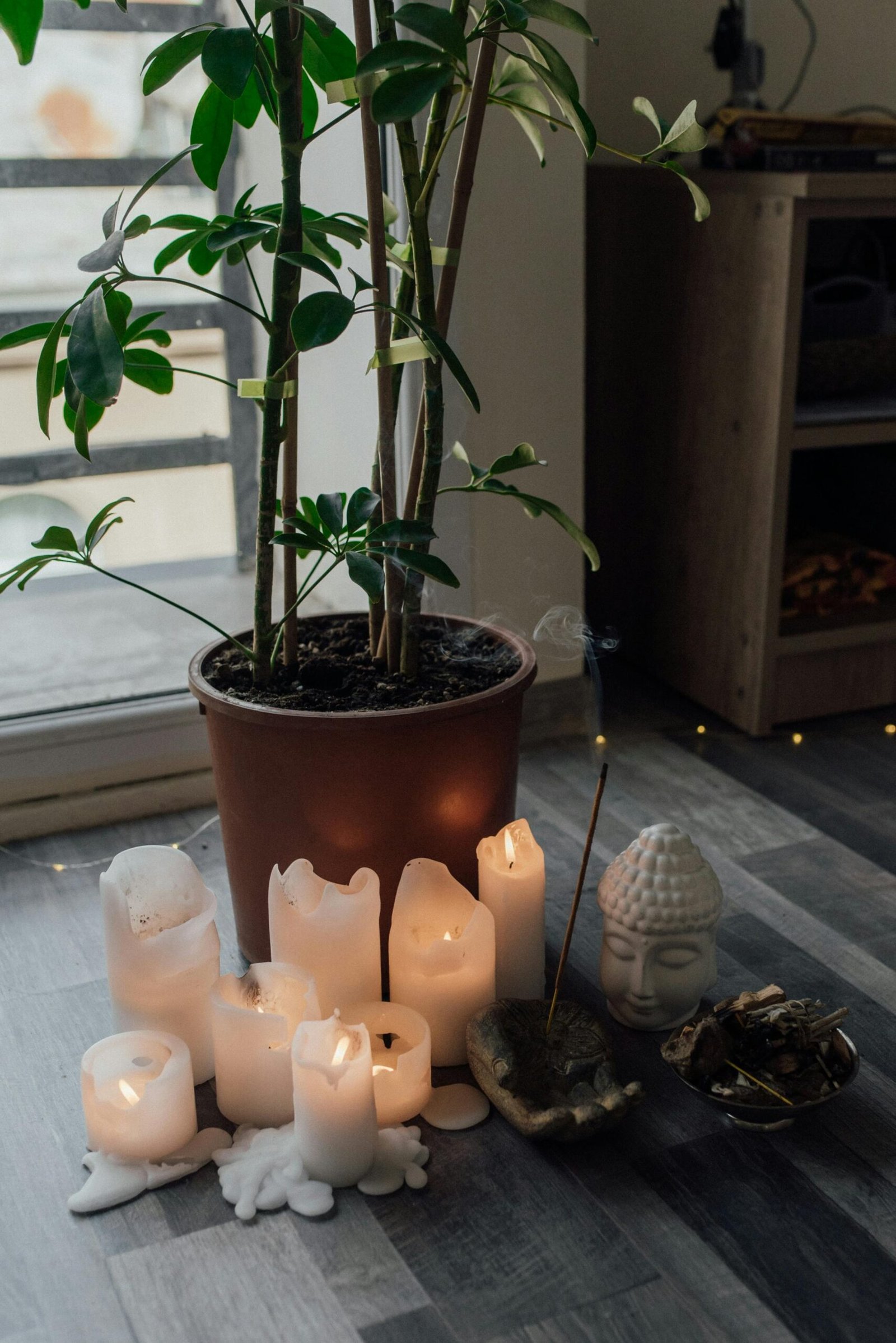
- A small candle or Himalayan salt lamp for ambient warmth
- One or two plants — studies show that biophilic elements like greenery reduce cortisol by up to 37%
- A simple altar or focal point: a crystal, a meaningful photograph, a small statue — whatever resonates personally
Sound: Controlling Your Acoustic Environment
Sound is one of the most overlooked elements of meditation space design. External noise — traffic, neighbours, family members — can be a significant barrier to deep practice. A few practical strategies can help significantly.
Soft furnishings absorb sound naturally, so adding a thick rug, cushions, curtains, and even a tapestry to your walls will reduce echo and external noise. A white noise machine or a small Bluetooth speaker playing binaural beats, Tibetan singing bowls, or nature soundscapes can mask intrusive noise effectively. Apps like Calm, Insight Timer, and Brain.fm remain among the most trusted in 2026 for ambient meditation audio.
Scent: The Fastest Path to the Parasympathetic State
Your olfactory system connects directly to the limbic system — the emotional brain — which is why scent can shift your mental state faster than almost any other sensory cue. Certain aromas have a well-documented association with relaxation and meditative states.
Lavender remains the most researched, with multiple clinical trials demonstrating its ability to reduce anxiety and lower heart rate. Frankincense has been used in spiritual practice across cultures for millennia and is now supported by neuroscience as a mild psychoactive that promotes a sense of transcendence. Sandalwood and cedarwood are grounding, earthy scents particularly suited to body-scan and mindfulness practices.
Use a diffuser with pure essential oils rather than synthetic air fresheners, which can contain volatile organic compounds. Incense is another traditional option — just ensure the space is adequately ventilated. Once you consistently use the same scent in your meditation space, your brain will begin to associate that aroma with stillness, deepening the environmental cue response over time.
Touch: The Ground Beneath You
Physical comfort is non-negotiable. Discomfort during meditation doesn’t build character — it builds distraction. Invest in a quality meditation cushion (a zafu or zabuton), a folded blanket, or a supportive yoga mat depending on your preferred posture. Many practitioners also keep a light throw blanket nearby, as body temperature can drop during prolonged stillness.
The texture of your space matters too. Soft, natural materials — cotton, linen, wool, bamboo — contribute to a sensory environment that signals safety and ease. Avoid synthetic, scratchy, or cold surfaces in your immediate contact zone.
Decluttering and Intention: The Non-Negotiable Foundation
A cluttered space creates a cluttered mind. This isn’t just spiritual wisdom — it’s supported by neuroscience. A landmark study from Princeton University found that visual clutter competes for neural resources in the brain, reducing the ability to focus and increasing background stress hormones. When you create a calming meditation space at home, clearing that space is an act of mental hygiene.
Purposeful Minimalism
You don’t have to live as a minimalist to maintain a minimal meditation space. Simply designate this area as a clutter-free zone. Nothing enters your meditation corner that doesn’t serve calm or practice. That means no work files, no charging cables left out, no random objects placed there because they had nowhere else to go.
Perform a quick tidy before each session if needed — many practitioners find that the act of arranging the space is itself a mindfulness ritual that eases the transition from busy mind to present awareness. Light your candle, set out your cushion, take three breaths. The body begins responding before you’ve even closed your eyes.
Setting Intention in Your Space
Consider adding one or two objects that carry personal meaning — not for spiritual performance, but for psychological anchoring. This might be a photograph of someone you love, a small piece of nature (a stone, a shell, a dried flower), or a written intention card. These items serve as visual affirmations of why you’ve created this space and what you’re cultivating within it.
Technology, Boundaries, and the Art of Unplugging
In 2026, the average adult in English-speaking countries spends over 7 hours per day on screens, according to data from DataReportal’s Global Digital Report. Your meditation space must act as a sanctuary from this constant digital stimulation — and that requires both physical and psychological boundaries.
Making Your Space a Phone-Free Zone
This is the most impactful single rule you can implement. Leave your phone outside the space — or at minimum, switch it to aeroplane mode and place it face-down and out of reach. The mere visibility of a smartphone, even switched off, has been shown in research from the University of Texas at Austin to reduce available cognitive capacity. Your meditation space deserves to be genuinely phone-free.
If you use a meditation app for guided sessions, consider a dedicated tablet or old smartphone that stays in the space solely for that purpose, with no other apps installed. This keeps the technology purposeful rather than distracting.
Communicating Boundaries With Household Members
One of the most common challenges for parents, partners, and housemates is interruption. Have a direct, kind conversation about your practice and what you need. A simple visual cue — a specific cushion placed outside the door, a small sign, a closed door — can communicate “please don’t disturb” without requiring anyone to tiptoe around indefinitely. Most people in your household will respect a clearly communicated, time-limited boundary.
Sustaining the Practice: Rituals That Make Your Space Come Alive
Creating a beautiful space is only half the work. The other half is showing up to it — especially on the days when motivation is low, life feels chaotic, and the cushion seems impossibly far from the couch.
Building a Pre-Meditation Ritual
Rituals serve as transition signals between your ordinary mind and your meditative one. They don’t need to be elaborate. A simple sequence — brewing a cup of herbal tea, lighting a candle, spending 60 seconds stretching — can be enough to shift your nervous system into receptive mode. The key is consistency: do the same sequence each time, and over weeks, the ritual itself becomes a meditation bell.
Starting Small and Building Gradually
Research consistently shows that the most sustainable meditation habits begin with sessions of just 5 to 10 minutes. A 2023 meta-analysis in Psychological Bulletin found that even brief daily mindfulness practice — as little as 8 minutes — produced measurable reductions in anxiety and improvements in attention regulation over an 8-week period. Use your beautiful new space for just 10 minutes a day to start. Consistency beats duration every time.
Seasonal and Intentional Updates
Refresh your space with the seasons — not because it’s necessary, but because it keeps the environment feeling alive and intentional. Swap out a candle scent in winter for something warming like cinnamon or clove. Add a seasonal flower in spring. Move your cushion closer to an open window in summer. These small changes prevent the space from becoming invisible to your brain — which tends to stop noticing things that never change.
Frequently Asked Questions
Do I need a large space to create a meditation area at home?
Absolutely not. Some of the most effective meditation spaces are the smallest. A corner measuring just one metre by one metre is enough for a cushion, a candle, and a sense of intention. What matters is consistency — your brain responds to returning to the same spot repeatedly, regardless of its size. Converted closets, bedroom corners, and balcony spaces all work beautifully. If you truly have no permanent spot, a dedicated cushion or mat that you place in the same location each day serves the same neurological purpose.
What’s the most important element of a calming meditation space?
While every element contributes, most mindfulness teachers and environmental psychologists agree that consistency of location is the single most powerful factor. Your brain builds an association between that specific spot and a calm, focused mental state — which means the space itself begins to do some of the work for you over time. Beyond location, removing visual clutter and eliminating digital distractions are the two highest-impact physical changes you can make.
Can I meditate in a space shared with others, like a living room?
Yes, with some adjustments. Use a specific cushion or mat that signals to both you and others that practice is happening. Communicate boundaries kindly and clearly. Use headphones with ambient sound to create an acoustic boundary within a shared space. Many people successfully meditate in shared environments by treating their mat or cushion as their portable sanctuary. Over time, your household may even find your practice inspires their own.
How do I stay motivated to use my meditation space regularly?
Start with a commitment so small it feels almost silly — five minutes, three times per week. Place your cushion somewhere visible so it serves as a gentle visual reminder. Tie your practice to an existing habit: after your morning coffee, before your evening shower, after putting the children to bed. Research on habit formation consistently shows that linking a new behaviour to an established one — known as habit stacking — dramatically increases follow-through. And remember: even sitting in your space without meditating formally is still a moment of intentional pause.
What are the best scents for a meditation space?
Lavender is the most clinically supported for anxiety reduction and relaxation. Frankincense is widely used across spiritual traditions and is now known to produce mild calming neurological effects. Sandalwood and cedarwood are grounding and earthy, ideal for present-moment awareness practices. Peppermint can support alertness if you meditate in the morning and struggle with drowsiness. Use pure essential oils in a diffuser where possible, and choose a scent you genuinely love — personal association matters as much as clinical research when it comes to the relaxation response.
Is it necessary to spend a lot of money to create a meditation space?
Not at all. Some of the most peaceful meditation spaces cost almost nothing. A folded blanket serves as a cushion. Sunlight through a curtain provides beautiful ambient light. A pinecone or river stone from outside becomes a meaningful focal object. A free app provides guided meditation audio. The investment that matters most is your time and attention — the physical elements simply support the intention you bring to the space. That said, if a quality cushion or a beautiful diffuser makes you more likely to show up consistently, it is absolutely a worthwhile investment in your wellbeing.
How long does it take before a meditation space starts to feel effective?
Most people notice a difference within one to two weeks of consistent daily use — even if sessions are brief. The brain’s associative learning is remarkably efficient: return to the same space, in roughly the same way, at roughly the same time, and the environmental cues begin to trigger a relaxation response within the first few minutes of sitting down. After four to six weeks, many practitioners report that simply entering the space begins to ease tension before they’ve even closed their eyes. The space, in essence, learns your intention alongside you.
Your Calm Harbour Awaits
Creating a calming meditation space at home is one of the most loving things you can do for your mental wellbeing — and it doesn’t require perfection, a large budget, or a dedicated room. It requires only a corner, a little intention, and the willingness to return to that corner again and again, even when life feels full and the minutes feel scarce.
You deserve a place in your own home where the world quiets down and you can simply breathe. Start today with whatever you have — a cushion on the floor, a candle, five uninterrupted minutes. That is enough. That is always enough. And with each visit to your space, you are building not just a meditation corner, but a lasting relationship with your own calm — one breath at a time.
Begin with just five minutes today. Your nervous system — and your future self — will thank you.
Leave a Reply